🪶 Winnetou – What Karl May Got Right and What He Got Completely Wrong
Winnetou is the most famous “Indian” in German-speaking countries – and he never existed. Karl May invented him between 1875 and 1909 in his study in Radebeul, Saxony, without ever having met an Apache or visited North America. Yet this fictional character shaped the image that generations of Germans, Austrians, and Swiss hold of indigenous peoples to this day. Then came August 2022: publisher Ravensburger withdrew a children’s book, Germany erupted in debate, social media burned. But behind the noise lies an important question that almost no one asked seriously: What did Karl May actually get right – and what did he get wrong? We take a close look.
✍️ Karl May: The Man Who Was Never There
Karl May (1842–1912), born in Ernstthal, Saxony, was a trained elementary school teacher who spent over seven years in prison for multiple counts of fraud and document forgery. He wrote his first Winnetou text in 1875 – at a time when he spoke neither English nor Apache, had made no trip to North America, and drew all his knowledge of the “Wild West” from other novels, travel accounts, and his own imagination.
Native Inspiration & Wisdom




Particularly audacious: May claimed for years to his readers that he was identical to his first-person narrator Old Shatterhand – that he had actually met Winnetou, actually ridden across the prairies. He had himself photographed with a hunting rifle he had purchased, which he called “Silberbüchse” (silver rifle). Only under pressure from legal proceedings did he admit that his works were fiction.
His first – and only – trip to North America took place in 1908: one year before his death, 33 years after the first Winnetou text. He was 65 years old.
📊 The Big Fact Check: Winnetou vs. Reality
- 🔴 Winnetou is chief of the Mescalero Apache → FALSE. The Apache had no hereditary chiefs – leadership was situational, chosen by merit.
- 🔴 “Apache” is a proud tribal name → FALSE. “Apache” comes from the Zuni language and means “foreign enemy” – some translations are even harsher. The Apache’s own name for themselves is Ndé – “the People.”
- 🔴 Winnetou dies a Christian, singing Ave Maria → FALSE. The Apache had complex spiritual traditions of their own – no deathbed conversion to Christianity.
- 🔴 Winnetou speaks fluent German → FALSE. There was no realistic basis for an Apache warrior speaking fluent German in the 19th century.
- 🔴 The Apache lived in tipis → FALSE. Tipis are Plains culture (Lakota, Cheyenne, etc.). The Apache lived in wickiups – dome-shaped structures of branches and hides.
- 🔴 Conflicts are resolved through reason and friendship → OVERSIMPLIFIED. The historical reality was land theft, massacres, forced reservations – no happy ending through interethnic friendship.
- 🟡 The Apache were extraordinary warriors → LARGELY TRUE, but with wrong connotations. Real chiefs like Cochise and Geronimo were tactically brilliant – but out of necessity, not adventurousness.
- 🟡 There were real conflicts between whites and Apache → TRUE. May just romanticizes them as adventure rather than systematic destruction.
- 🟢 Winnetou respects nature and his people → CORRECT AS A VALUE. But expressed as cliché, not as lived cosmology.
🔴 What Karl May Got Completely Wrong
1. “Apache” – An Insult Used as a Hero’s Name
The word “Apache” comes from the Zuñi language and means roughly “foreign enemy” – some translations go further: “idiot” or “enemy for no reason.” It was an outsider name, not a proud self-designation. The Apache’s own name for various groups is Ndé (Chiricahua, Mescalero) – meaning “the People.” Karl May adopted the colonial outsider name as a heroic title without knowing what it meant.
2. Winnetou Would Never Have Been Chief Among Real Apache
Apache societies had no hereditary chiefs. Leaders were chosen situationally – for a raid, a hunting season, a negotiation – and selected for concrete competence: military strategy, knowledge of terrain, negotiating skill. A young man like Winnetou, distinguished by novelistic virtues, would have commanded no following in historical Apache reality. As Winnetou researcher Thorsten Kolle put it: had Karl May’s invented “noble savage” really existed, no tribe would have suited him less than the Apache.
3. The Deathbed Conversion – A Colonial Fantasy
One of the most discussed scenes in the Winnetou novels: the dying Winnetou whispers to Old Shatterhand: “Schar-lih, I believe in the Savior. Winnetou is a Christian.” A chorus of white settlers sings the Ave Maria. This is not literary license – it is colonial ideology in pure form. The message: even the noblest indigenous person finds fulfillment in Christianity. The real Apache had deep, complex spiritual traditions of their own – ceremonies, power spirits, healing rituals, and a cosmology that had nothing to do with and wanted nothing to do with Christian doctrine.
4. Tipis, Feather Headdresses, War Paint – All Wrong
The image of the “typical Indian” – tipi, eagle feather headdress, reddish-brown war paint, tomahawk – derives largely from Plains peoples’ culture (Lakota, Cheyenne, Comanche). The Apache lived in wickiups – domed huts of branches, grass, and hides, perfectly suited to the hot desert and mountain climate of the Southwest. They wore high-shafted moccasins and leather clothing – but not monumental feather headdresses. Karl May merged the cultures of all indigenous peoples into a single cliché. That is like a Chinese author writing a “typical European” who simultaneously wears lederhosen, dances flamenco, and makes pasta.
5. Winnetou’s German – Linguistically Absurd
In the novel Winnetou speaks fluent German, English, Spanish, and several Native languages. For an Apache warrior of the 1860s–70s, this is simply impossible. The reality: the Apache spoke their own language (Athabaskan), some Spanish from the Mexican colonial period – but no German. The only Germans real Apache encountered were mercenaries in the U.S. Army or occasional traders. No exchange of language at fictional-hero level.
🟡 What Karl May Oversimplified
6. The Apache as Extraordinary Warriors – Right, but for the Wrong Reasons
That the Apache were militarily extraordinary is historically documented. But Karl May portrays this as a kind of noble adventurousness. The reality was different: the Apache fought because they had to. Their homeland – the region of present-day Arizona, New Mexico, and northern Mexico – had been claimed since the 16th century by the Spanish, then in the 19th century by Mexico and the United States. Their fighting was self-defense, not romantic adventure.
7. Old Shatterhand as the “Good White Man” – a Convenient Exception
May resolves the moral problem of colonization elegantly: he invents the “good white man” – Old Shatterhand, who respects the Apache, learns their language, becomes Winnetou’s blood brother. In reality there were indeed individual whites who respected and defended indigenous peoples. But the exception served May to silence the rule: systematic land theft, treaty breaking, massacres, and the destruction of Apache life through reservation and forced assimilation.
🟢 What Karl May – Despite Everything – Got Right
8. Winnetou Awakened Empathy – and That Is Not Nothing
Here the debate becomes complex. Generations of German children developed an emotional connection to the subject of indigenous cultures through Winnetou. Some of them later became ethnologists, activists, or attentive citizens in debates about land rights. Ethnologist Susanne Schröter (Goethe University Frankfurt) put it well in 2022: “Someone who reads Winnetou as a child can, if interested, also read nonfiction or academic works about Native Americans.” Winnetou as an entry point is not the problem. Winnetou as the only source is.
9. May Condemned the Land Grab – in His Way
In the novels, European intruders – with the exception of Old Shatterhand and a few others – are portrayed as greedy, brutal, and dishonorable. May did not write: “The whites are right.” He wrote: “The whites are destroying something beautiful.” That is naive and oversimplified – and yet it was a stance that was by no means self-evident in Germany in 1875.
⚡ The Ravensburger Debate 2022: What Really Happened
In August 2022 the children’s film “Der junge Häuptling Winnetou” (The Young Chief Winnetou) opened in German cinemas. Publisher Ravensburger released an accompanying children’s book. What followed was one of the loudest cultural debates of the year:
- August 11, 2022: Criticism explodes on Instagram. Accounts label the book “harmful” and describe it as “romanticizing genocide.”
- Ravensburger withdraws: The publisher concluded that “given the historical reality of the oppression of the indigenous population, a romanticizing image full of clichés is being drawn here.”
- Counter-reaction on Twitter: Hundreds of users accuse Ravensburger of “cancel culture” and cowardice.
- Film critic Daniel Kothenschulte (Frankfurter Rundschau) wrote: “How is it possible that a film already transporting colonialist and racist stereotypes in its screenplay is funded with millions in federal and state money?”
- “Natives in Germany” – an Instagram account by and for indigenous people in Germany – stated clearly: “The film is racist.”
What was almost entirely missing from the debate: the voice of today’s Apache themselves. The Mescalero Apache Tribe and the Chiricahua Apache are federally recognized tribes in New Mexico and Oklahoma. Nobody asked them.
🏹 The Real Apache: What Winnetou Suppressed
While Germany debated Winnetou, the real descendants of the Apache were living in New Mexico, Arizona, and Oklahoma – often under difficult social conditions, with high poverty rates on reservations and ongoing struggles for land rights and cultural revitalization. The four historical leaders who actually existed were:
- Mangas Coloradas (c. 1793–1863) – chief of the Mimbreño Apache, murdered in U.S. military custody. His skull was severed by the U.S. Army and used as a display object for decades.
- Cochise (c. 1805–1874) – chief of the Chiricahua Apache, for years a peace partner of the U.S., until a U.S. officer in 1861 took his brother and nephews hostage and had them murdered. Cochise then waged eleven years of resistance.
- Victorio (c. 1825–1880) – fought against forced relocation to an uninhabitable reservation. Was lured into an ambush in Mexico with his group and killed.
- Geronimo (Goyaałé, 1829–1909) – the last free Apache warrior. When Mexican troops killed his mother, wife, and three children in 1858, he swore revenge. He fought until 1886 – and died on February 17, 1909, of pneumonia while still a prisoner of war at Fort Sill. On his deathbed he said: “I should never have surrendered.”
These are the real Apache. No blood-brother ritual with a Saxon writer. No Ave Maria death. No silver rifle.
✅ Practical Wisdom: How to Engage with Winnetou Responsibly Today
- Read Winnetou for what it is: fiction. Karl May wrote adventure novels – not an ethnology textbook. Read as a fantasy work, Winnetou is a product of its time. As an information source, it is dangerous.
- Get to know the real Apache. Geronimo, Cochise, Victorio, Mangas Coloradas – four real men whose life stories are more dramatic, complex, and moving than any Karl May novel.
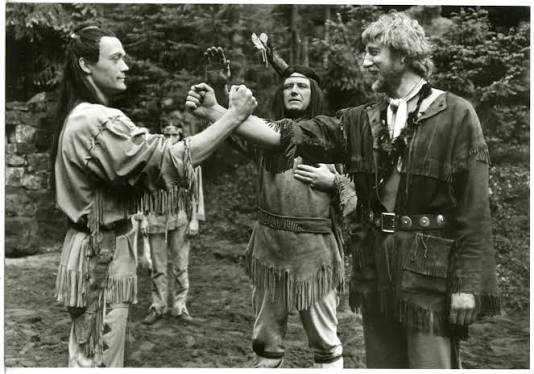
- Recognize “redfacing.” White actors in reddish make-up and dark wigs playing Native Americans – that is called “redfacing” and is the racist equivalent of blackface. Pierre Brice was French. That was never acceptable.
- Give children context. If children read Winnetou or see the film: explain that this is a fantasy character, and read real stories about indigenous peoples alongside it.
- Listen to indigenous voices from Germany. The network Natives in Germany and the MDR podcast “Winnetou ist kein Apache” (6 episodes, 2022) offer authentic perspectives.
- Reconsider costumes. Feather headdresses and “Indian” costumes at carnival or festivals are no homage – they reduce a living culture to a stage cliché.
- Read real literature by indigenous authors. Bury My Heart at Wounded Knee by Dee Brown (1970), An Indigenous Peoples’ History of the United States by Roxanne Dunbar-Ortiz (2014), or Braiding Sweetgrass by Robin Wall Kimmerer (2013) – these are the counter-program to Karl May.
❓ Frequently Asked Questions about Winnetou and Karl May
Did Karl May ever meet a real Apache?
Almost certainly not. May wrote the first Winnetou text in 1875 without any North American experience. His first and only U.S. visit took place in 1908 – 33 years later, one year before his death. All his knowledge of indigenous peoples came from other books, travel accounts, and his imagination.
Why did Ravensburger really pull the book?
Officially because of “trivializing clichés about the treatment of the indigenous population.” In practice it was a response to massive pressure on social media, primarily on Instagram. Whether the decision was correct remains disputed – but the criticism behind it was legitimate.
Is “Apache” really a slur?
The name comes from the Zuni language and means “foreign enemy” – some translations are even harsher. The Apache’s own designation is Ndé (Chiricahua, Mescalero) – “the People.” Karl May knew none of this. Today many Apache groups use the name themselves – it has become an identity term across generations, despite its origins.
Who played Winnetou in the films – and why is that problematic?
In the famous 1960s films, Frenchman Pierre Brice played Winnetou in a dark wig and reddish make-up. This is “redfacing” – lighter-skinned actors appearing as indigenous people through costume and makeup. In the U.S. this has been considered unacceptable for decades. In the German-speaking world it was only widely discussed after the 2022 debate.
Are there still real Apache today?
Yes. Several Apache nations are federally recognized tribes in the U.S. today: the Mescalero Apache Tribe (New Mexico), the San Carlos Apache Tribe (Arizona), the White Mountain Apache Tribe (Arizona), and others. They run their own governments, schools, and cultural programs. They are not relics of the past – they are living communities.
Should Winnetou be banned?
No – that is the wrong question. Winnetou is a literary-historical document and valuable as such. The right question is: how do we read it? With context, critical thinking, and the knowledge that behind the fantasy figure stand real peoples whose history is far more complex and tragic than any novel.
🪶 Conclusion: Winnetou Opened a Door – But the Truth Waits Behind It
Karl May did not set out to write ethnology. He wanted to tell adventures – and in doing so he dreamed of a better world in which a Saxon desk-bound writer and an Apache chief become blood brothers. That is humanly understandable. And historically devastating.
The real Apache – Cochise, Geronimo, Victorio – did not fight for adventure. They fought for their land, their families, their survival. They lost. Their descendants live today on reservations comprising a fraction of their original territory.
Winnetou is the door. The real story is the house behind it. It is time to go in.
TribesNative.com – Where Tradition Meets Truth.