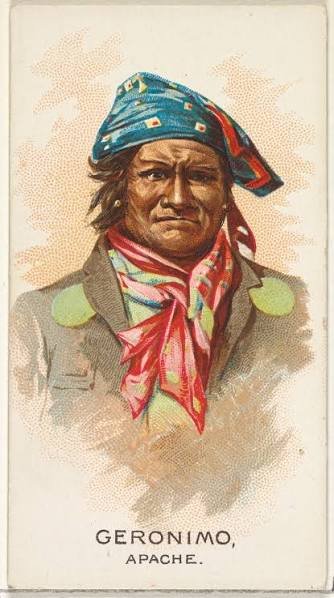
🪶 Geronimo – The Life of the Last Free Warrior
His name is a battle cry. Paratroopers shout it jumping from planes. Adventurers yell it leaping from cliffs. Children play him on schoolyards. But almost no one knows the man behind it – the man who was called Goyaałé, meaning simply: “the one who yawns.” A man who lost his mother, his wife, and his three children in a single evening. Who then fought for 28 years – with eventually 35 warriors against a quarter of the entire U.S. Army. Who took his last breath as a prisoner of war in a foreign state, far from his homeland, after 23 years of imprisonment without charge. And whose last recorded words were: “I should never have surrendered. I should have fought until I was the last man.”
This is not the story of a Hollywood villain. It is the story of a man who fought for the same things Western democracies claim to fight for: freedom, family, and the land of his ancestors.

Not alone with loneliness
A companion for more mindfulness and inner strength.
Explore on Amazon🌵 Origins: Who Was Goyaałé Really?
Goyaałé – known to the world as Geronimo – was born on June 16, 1829 in No-Doyohn Canyon, a valley in the present-day borderlands of Arizona and New Mexico, then still part of Mexico. He was the fourth of eight children and grew up in the Bedonkohe band of the Chiricahua Apache – one of the most fiercely free-spirited groups of the North American Southwest.
In 1846, at age 17, he was admitted to the warriors’ council. He himself described this moment in his autobiography dictated to S.M. Barrett in 1905: “This would be glorious. I hoped soon to serve my people in battle.”
That same year he married Alope, daughter of a Chiricahua leader. The bride price: a herd of ponies. They had three children. Life was hard but free – the Bedonkohe land was their world, and it was complete.
💔 The Night That Changed Everything: Janos, 1851
In the summer of 1851, Goyaałé’s group traveled to Janos, Chihuahua, Mexico, to trade. The men went into town. The women and children remained at camp, guarded by a few warriors. When the men returned that evening they found the camp destroyed. Mexican soldiers under Colonel José María Carrasco had attacked. Killed: Goyaałé’s mother, his wife Alope, and his three children.
He described the aftermath himself:
“I stole away into the night. Long I sat still. Finally I rose and wandered through the forest until dawn. No song could I sing, no prayer could I speak. There was nothing.”
In the night of his deepest solitude, tradition holds, he heard a voice:
“No gun will ever kill you. I will take the bullets from the guns of the Mexicans… and guide your arrows.”
Geronimo was never wounded by a bullet in his long warrior life – a fact his followers regarded as proof of supernatural protection.
⚔️ The Name: Why “Geronimo”?
The name “Geronimo” is not a self-designation and not an Apache word. It arose during one of his revenge battles against Mexican troops – likely at the Battle of Arizpe (1859), where Goyaałé fought so fearlessly that the Mexican soldiers, in terror, called upon the patron saint Jerome (Spanish: Gerónimo/Jeronimo) to protect them. Listening Americans interpreted the cry as his name.
That the world knows him by the name of a Christian saint his enemies cried in mortal fear is one of the bitterest ironies of this story.
🏔️ San Carlos Reservation: Hell on Earth
In the 1870s, the U.S. federal government began forcing all Apache groups onto the San Carlos Reservation in Arizona – a parched, barren stretch of land by the Gila River that Geronimo and his contemporaries described as “Hell on Earth.” It offered no hunting, no fertile land, no connection to the mountains and forests where the Apache had lived for generations.
Apache agents of the U.S. government controlled food distribution, manipulated rations, and enriched themselves personally. Ceremonies were banned. The Apache language was suppressed in schools. Men who had lived as free warriors and hunters were made dependent on a bureaucratic system that treated them as incompetent.
Geronimo broke out multiple times – 1878, 1881, 1885. Each time he returned or was captured. Each time he drew more men, women, and children with him into freedom – and into pursuit.
🏃 The Great Flight 1885–1886: The Military Miracle
In May 1885, Geronimo broke out of the reservation for the last time. With him: 35 warriors, 8 boys, and 101 women and children. What followed was one of the most astonishing military survival struggles in history.
The numbers:
- On Geronimo’s side: at most 35 fighting men
- Against him: at peak over 5,000 U.S. soldiers and 3,000 Mexican troops – one quarter of the entire active U.S. Army
- Duration of the pursuit: 18 months
- Distance covered: over 3,000 kilometers through deserts, canyons, and mountains
- Geronimo’s group covered up to 120 kilometers per day – on foot through the most rugged terrain
- The U.S. Army never got anywhere near direct contact in those 18 months
General Nelson Miles, tasked with Geronimo’s capture, wrote: “Geronimo was the most cunning, brave, and enduring individual I encountered in my entire military career.”
😔 The Surrender: Skeleton Canyon, September 4, 1886
On September 4, 1886, Geronimo surrendered in Skeleton Canyon, Arizona – for the last time. Not because he had been defeated. Not because the army had cornered him. But because he was exhausted, his group was starving, and Lieutenant Charles B. Gatewood – a man Geronimo personally trusted – acted as mediator and conveyed promises.
General Miles promised Geronimo: after a period of exile in Florida, he and his people would be permitted to return to Arizona. This promise was never kept.
Geronimo and his group were not treated as free people – they were classified as prisoners of war. First deported to Fort Pickens, Florida, then to Mount Vernon Barracks, Alabama, finally to Fort Sill, Oklahoma – ever farther from their homeland. The climate in Florida and Alabama killed many Apache unaccustomed to humidity and heat. Children died. Elders died.
🎪 The Humiliation: Displayed Like an Exhibit
What followed was one of the most shameful episodes in American history. The U.S. government recognized that Geronimo’s name had commercial value – and exploited it shamelessly:
- 1898: Exhibited at the Trans-Mississippi World’s Fair in Omaha, Nebraska – as a living attraction.
- 1904: Appears at the World’s Fair in St. Louis. Sells photographs of himself and handcrafted bow-and-arrows.
- 1905: Rides in President Theodore Roosevelt’s inauguration parade – at Roosevelt’s express request, who wanted him as a spectacular crowd spectacle.
Geronimo petitioned Roosevelt multiple times – personally and in writing – for permission to return to Arizona to die on the land of his ancestors. Roosevelt refused. Military authorities feared his return could trigger new unrest.
💀 Death: Fort Sill, February 17, 1909
In the winter of 1909, Geronimo rode alone and drunk from a trade visit and fell from his horse. He lay in the frost through the entire night. The next morning he was found – gravely ill. He was brought to the infirmary at Fort Sill, Oklahoma, where he died of pneumonia.
Died: February 17, 1909. Age: approximately 79 or 80. Status: prisoner of war. Still. After 23 years of imprisonment without charge, without trial, without conviction.
His last known words to his nephew:
“I should never have surrendered. I should have fought until I was the last man.”
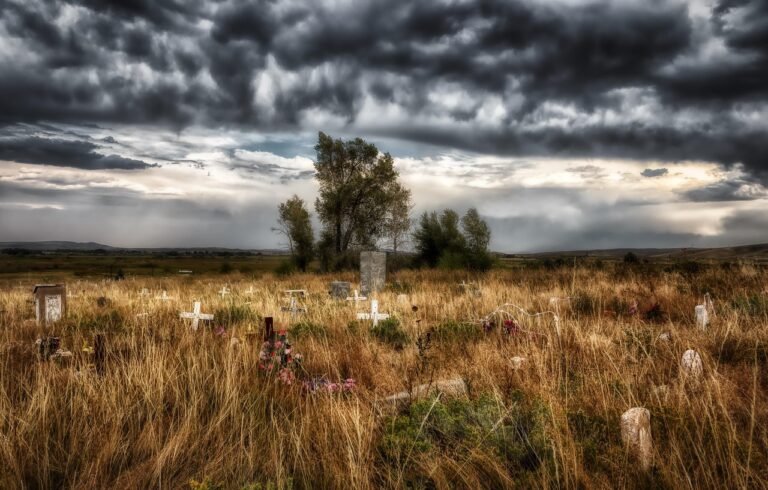
He was buried in the Apache Cemetery at Fort Sill – beneath a simple headstone, in the soil of a state he never knew as home. He never saw Arizona again.
💀 The Skull Legend: Yale and the Suspicion of Grave Robbery
In 1918, a group of members of Yale University’s secret society Skull and Bones, allegedly led by Prescott Bush (father of George H.W. Bush), is said to have opened Geronimo’s grave at Fort Sill and stolen his skull. The skull is allegedly kept to this day in the society’s secretive “Tomb” in New Haven, Connecticut.
Geronimo’s descendants – including his great-grandson Harlyn Geronimo – have demanded the return of his remains for decades. In 2009, on the centennial of his death, they sued Skull and Bones and the U.S. government – without success. The lawsuit was dismissed.
Whether true or legend: the idea that the skull of the last free Apache warrior is kept as a trophy in a secret society says everything about the relationship between the American power elite and indigenous history.
🎬 Geronimo in Film and Culture
- “Geronimo” (1962), dir. Arnold Laven – Chuck Connors, a white actor, plays Geronimo in makeup and wig. Historically naive but made with serious intent.
- “Geronimo: An American Legend” (1993), dir. Walter Hill – with Wes Studi (Cherokee) in the lead, Gene Hackman, Robert Duvall, and an early Matt Damon. Wes Studi himself fought to ensure no white actor took the role. The result is the most historically accurate and artistically significant Geronimo film. Available on Netflix.
The cry “Geronimo!” in parachuting dates to World War II. A soldier of the 501st Parachute Infantry Regiment – reportedly Private Aubrey Eberhardt – shouted the name on his first jump in 1940 to compare his own fearlessness to the Apache warrior. From an indigenous perspective, it is a profound act of appropriation: the name of a man who died as a prisoner of war became a symbol of carefree adrenaline.
✅ Practical Wisdom: What Geronimo’s Life Teaches Us Today
- Resistance needs no weapons. Geronimo’s greatest achievement was not military – it was the sheer refusal to accept his people’s erasure as inevitable.
- Promises must be kept. The U.S. government broke the promise General Miles made to Geronimo. This was not accidental – it was method. The history of treaties between the U.S. government and indigenous peoples is a history of systematic treaty-breaking. Over 500 treaties – not one fully honored.
- The name does not belong to the culture that coined it. “Geronimo!” as an adrenaline shout ignores the human behind it. Learn the person before you shout the name.
- Imprisonment without conviction is injustice – then as now. Geronimo spent 23 years in detention without charge, without trial, without verdict – in the era of the U.S. Constitution and the Bill of Rights.
- Read Geronimo’s own words. Geronimo: His Own Story (1905/1906), recorded by S.M. Barrett, is one of the very few direct testimonies of an indigenous warrior from this era. Accessible, moving, and devastating in its simplicity.
❓ Frequently Asked Questions about Geronimo
Was Geronimo really a chief?
No – that is one of the most common misconceptions. Geronimo was not a chief (Naiche, son of Cochise, was the actual chief of the Chiricahua). Geronimo was a warrior and shaman – a leader by virtue of his personal abilities, supernatural gifts, and authority in war situations. Among the Apache, leadership was situational and merit-based, not hereditary.
What does Goyaałé mean?
Goyaałé (also spelled Goyathlay) means “the one who yawns” in Chiricahua Apache. It was his birth name. The name “Geronimo” arose when Mexican soldiers, terrified during a battle, called upon the patron saint Hieronymus (Spanish: Gerónimo) – and watching Americans interpreted the cry as his name.
How long was Geronimo a prisoner of war?
From his surrender on September 4, 1886, to his death on February 17, 1909 – 22 years and 5 months. At no point was he charged, convicted, or brought before a court. His status as prisoner of war formally persisted until his death.
Why did “Geronimo!” become the paratrooper shout?
In 1940 a soldier of the 501st Parachute Infantry Regiment shouted the name on his first training jump – to demonstrate his fearlessness compared to the Apache warrior. The cry spread through the army and worldwide. From an indigenous perspective it is a problematic act of appropriation.
Did Geronimo regret his surrender?
By his own recorded words: yes – deeply. His final words to his nephew shortly before death were: “I should never have surrendered. I should have fought until I was the last man.” In interviews during his captivity he spoke variably – sometimes conciliatory, sometimes with unfiltered pain.
Are Geronimo’s descendants still alive?
Yes. Harlyn Geronimo, his great-grandson, is a prominent activist and spokesperson for the Apache community. The Chiricahua Apache live today as the Fort Sill Apache Tribe in Oklahoma and as part of the Mescalero Apache Tribe in New Mexico.
🪶 Conclusion: The Yawning One Who Keeps the World Awake
Goyaałé – the Yawning One – has kept the world awake. With 35 warriors against 5,000 soldiers. On horses and on foot against telegraph lines and railroads. With a conviction that no army could break, even when it imprisoned his body.
He lost. That is the historical truth. But he lost in a way that says more about his adversaries than about him. A quarter of the American army needed 18 months to find 35 men. And when they finally had him – through promises, not force – they did not keep their word for even a single day.
Geronimo died a prisoner of war. He never saw his homeland again. He was turned into a circus attraction. His name was turned into an adrenaline shout.
And yet: his last words were no plea for forgiveness, no reconciliation, no peace with his circumstances. They were the clearest expression of what he had always been: a man who refused to accept that freedom is a privilege that others can grant or take.
“I should never have surrendered.”
He was right.
TribesNative.com – Where Tradition Meets Truth.