🐺 Spirit Animal Wolf – Meaning, Message & True Indigenous Origins
The wolf is one of the most searched spirit animals worldwide – and simultaneously one of the most misunderstood. While countless spiritual websites reduce it to buzzwords like “intuition,” “freedom,” and “pack leader,” the indigenous peoples of North America, for whom the wolf has been a sacred being for millennia, tell a deeper, more complex, and more moving story. This article takes you to where the knowledge truly originates.
🌎 Where Does the Concept of “Spirit Animal” Actually Come From?
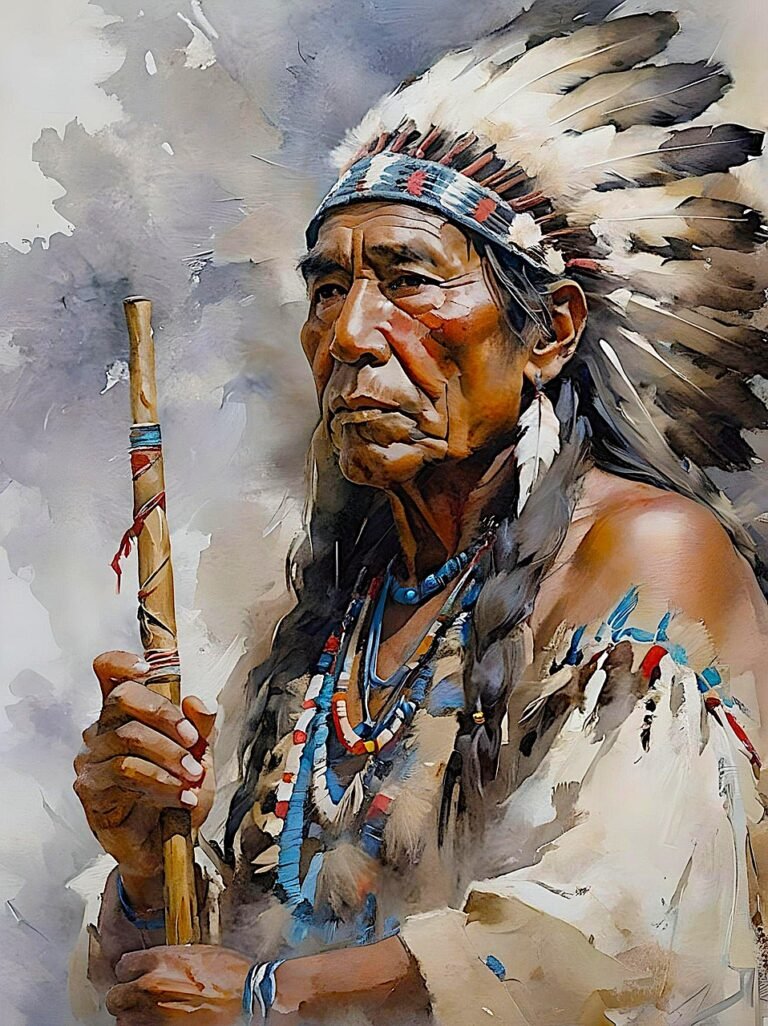
Before we get to the wolf, an important foundation: the concept of the spirit animal – also called Power Animal – originates from the shamanic traditions of indigenous peoples of North America, not from the Western esoteric shelf. In the traditions of the Lakota Sioux, Ojibwe, Cherokee, and many other nations, a spirit animal is not a personality quiz result, but a spiritual companion that reveals itself to a person through dreams, vision quests (Hanbleciya), or ceremonial experience.
Native Inspiration & Wisdom




Anthropologist Michael Harner popularized the concept in the West through his book The Way of the Shaman (1980). Since then it has spread rapidly through New Age culture, psychology blogs, and social media – often without naming the indigenous roots. TribesNative.com goes back to the source.
🐺 The Wolf in the Indigenous World of North America
For most indigenous peoples of North America, the wolf is not a symbol but a relative. The Nez Perce of present-day Idaho and Oregon called the wolf himiin maqsmáqs – and saw it as the brother of the human being, embodying the same qualities: loyalty to the pack, endurance on a long trail, the wisdom of elders passed to the young.
The Lakota Sioux of the Great Plains referred to the wolf as Shunkaha Manitou – the “sacred dog” or “spirit dog.” It was regarded as a warrior companion protecting scouting parties, and as a guardian of the vulnerable. In Lakota lore, the wolf is the one who walks alone but is never alone – a description of the spiritual path itself.
Among the Ojibwe (Anishinaabe) of the Great Lakes region, the wolf is called Ma’iingan. It holds a unique role in their creation story: when the first human, Nanabozho, explored the earth, the wolf was his only companion. The two journeyed together, naming all animals and plants. In the end they were separated – the human was to walk his path on earth, the wolf his own. Since then the Ojibwe say: “What happens to the wolf, happens to the human.” A sentence that takes on shattering depth in light of the parallel histories of wolf extermination and indigenous genocide.
🏹 The Wolf as Warrior and Teacher: Specific Tribal Traditions
Lakota – The Wolf as Strategic Teacher
Lakota warriors spiritually connected to the wolf formed the Wolf Warriors – scouts who rode out ahead of the main camp, surveyed terrain, and anticipated dangers. The wolf taught them not aggression, but its opposite: patience, observation, strategic thinking. A real wolf does not kill on impulse – it observes a herd for days, sometimes weeks. The Lakota transferred this quality to spiritual practice: whoever receives the wolf as a spirit animal is called to react less and observe more.
Cherokee – Wolf Clan and the Balance of the Pack
Among the Cherokee of the Southeast (present-day North Carolina, Georgia, Tennessee), the Aniwaya – the Wolf Clan – is one of the seven sacred clans. Traditionally, Wolf Clan members served as warriors and protectors of the community. They were responsible for the village’s safety and the training of young fighters. The clan member did not carry the wolf as an ego symbol but as an obligation: I serve the pack before I serve myself.
Ojibwe – Ma’iingan and the Shared Soul
In Ojibwe cosmology, wolf and human share an Odoodem – a totem soul. Those from the Wolf Clan may not kill or eat a wolf. Here the wolf is not an external power symbol but literally part of one’s own identity. This close bond explains why the Ojibwe are among the most determined advocates for wolf protection in North America – for them, the decimation of wolf populations is not an ecological issue but a spiritual violation.
Nez Perce – The Wolf as Guardian of Ecological Balance
The Nez Perce of the Pacific Northwest played a central role in the reintroduction of wolves to Yellowstone National Park (1995) – one of the most significant rewilding measures of the 20th century. For the Nez Perce this was not merely ecology but the fulfillment of a spiritual obligation: returning the brother of the human to his rightful place. Since then the Yellowstone ecosystem has recovered radically – river courses shifted, beavers returned, erosion stopped. Scientists call this a “trophic cascade.” Indigenous elders nodded and said: “We knew.”
🌑 Wolf and Moon – A Cosmic Bond
The connection between wolf and moon is no New Age invention – it has deep roots. In Lakota tradition, the moon is Hanwi (night light) and is closely related to feminine power and the cycle of time. The howling wolf is regarded as the one who holds dialogue with Hanwi – it calls not out of loneliness but out of connection.
Many Plains peoples oriented their lunar calendars around wolf activity. The “Wolf Moon” – the first full moon of January – is named in the tradition of the Algonquin peoples after the loudly howling wolf packs in the deepest winter nights. It was a reminder: even in the coldest, darkest time of year, the pack is together and its voice is heard.
🌿 What the Wolf as Spirit Animal Really Wants to Tell You – the Indigenous Message
From the various traditions, concrete, honest messages can be distilled – not wellness phrases, but real spiritual tasks:
- Serve the pack first. The wolf is not a symbol of the lone hero. It teaches that true strength lies in service to the community. Whoever receives the wolf is asked: Who do you live for?
- Observe before you act. Wolf Warriors of the Lakota spent years learning to read tracks, weather, and behavior. The wolf as spirit animal is an invitation to radical patience.
- Protect the vulnerable. In every pack the alpha pair leads – but the whole group cares for the elderly, injured, and young. Whoever carries the wolf bears the responsibility of the protector.
- Keep knowledge alive. In the Ojibwe story the wolf teaches the naming of the world. This is no coincidence: the wolf reminds us that knowledge must be passed on to survive.
- Trust the path in the dark. The wolf hunts at night, orienting itself by moon and stars. It trusts senses that reach beyond the visible. An invitation to follow one’s own intuition more seriously – not as a self-care tip, but as spiritual practice.
⚠️ Wolf as Spirit Animal – What You Should Know: Appropriation vs. Appreciation
“Spirit animal wolf” is a mass phenomenon today. Instagram, tattoo studios, oracle cards, candles, pendants – the wolf is everywhere. This is not automatically wrong, but it is worth looking honestly:
- A spirit animal in indigenous tradition is not chosen – it reveals itself. Someone who finds “their wolf” in an online quiz has an interesting result, not a spiritual experience.
- Wolf tattoos in “Native American style” without knowledge of the meaning reduce a sacred system to decoration. If the wolf draws you: learn the history behind it.
- Real spiritual contact with the wolf as spirit animal arises in silence, in nature, in the honest question: What do I give to this pack? – not: What can the wolf give me?
✅ Practical Wisdom: How to Develop a Real Relationship with the Wolf Spirit Animal
- Go outside. The wolf lives in the wilderness. A relationship with the wolf as spirit animal begins with not consuming nature but listening to it. Early morning, in silence, without a phone.
- Keep a dream journal. In Ojibwe tradition Ma’iingan often reveals himself in dreams. Record when and how he appears – not for self-optimization, but as spiritual dialogue.
- Learn from real sources. Black Elk Speaks (1932), Braiding Sweetgrass by Robin Wall Kimmerer (2013), and Of Wolves and Men by Barry H. Lopez (1978) offer deep insight into indigenous understanding of animals.
- Support wolf protection projects. Those who honor the wolf as spirit animal can act: organizations such as Defenders of Wildlife or wolf recovery programs supported by Nez Perce advocates work actively for wild wolves.
- Practice stillness and observation. Once a week, sit in nature for 20 minutes – with no goal, no phone. Observe. That is the wolf practice.
- Ask yourself daily: Did I serve my pack today? Did I protect someone more vulnerable? Did I pass on knowledge?
- Respect the boundary. If this subject moves you deeply: consider supporting indigenous communities and wolf protection projects directly – financially, politically, or through awareness work.
❓ Frequently Asked Questions about the Spirit Animal Wolf
What does it mean when the wolf appears in my dreams?
In Lakota tradition a wolf in a dream points to a test of loyalty – either you will soon be called to protect someone, or you yourself will need protection. In Ojibwe tradition the dream wolf is often Ma’iingan himself, delivering a message or task. In both cases: write the dream down and watch for situations in your life where community and protection play a role.
What is the difference between a totem animal and a spirit animal?
A totem animal (also: clan animal) is in indigenous tradition a collective animal – it belongs to a clan, a family, a people. It is inherited. A spirit animal is individual – it reveals itself to the individual person through dream, vision, or ceremony. The wolf can be both: Ma’iingan is the totem animal of the Ojibwe Wolf Clan and can simultaneously reveal itself to individuals as a personal spiritual companion.
Can I adopt the wolf as my spirit animal if I am not indigenous?
The concept of the spirit animal comes from a specific cultural practice. Someone who feels spiritually drawn to the wolf may take that seriously – but should know and respect the origins of this knowledge. No spirit animal “belongs” to you like a possession. It comes to you when it is ready.
What is the significance of the wolf’s color?
White wolf, black wolf, and gray wolf – in some Plains traditions these variants symbolize different spiritual qualities: the white wolf often stands for purity, clarity, and spiritual guidance; the black wolf for confrontation with the shadow, with suppressed aspects of the personality; the gray wolf for the balanced, mature being that is neither extreme nor lukewarm. These attributions vary, however, by tradition and elder.
How do I find out if the wolf is my spirit animal?
In indigenous practice one does not select a spirit animal – one prepares to receive it. This happens through silence, through time in nature, through dreams, and sometimes through a guided ceremony like the vision quest. In a modern context: if the wolf appears repeatedly in your life – in dreams, encounters, images – and if its message (loyalty, protection, observation) speaks to you, this may be no coincidence.
Which books are recommended for deeper study?
Black Elk Speaks by John G. Neihardt (1932), Braiding Sweetgrass by Robin Wall Kimmerer (2013), Of Wolves and Men by Barry H. Lopez (1978), and Spirit and Reason by Vine Deloria Jr. (1999).
🐺 Conclusion: The Wolf Does Not Wait for You – It Watches You
The wolf as spirit animal is no wellness symbol and no identity badge. It is an invitation to serious spiritual work: to humility in service, to patience in observation, to strength in connection. The indigenous peoples of North America, who have known the wolf as a sacred brother for millennia, have left us a legacy that reaches far beyond oracle cards and tattoos.
The wolf howls in the winter night – not because it is alone. But to remind the pack: I am here. Where are you?
TribesNative.com – Where Tradition Meets Understanding.